
CRM ARTICLE
Implement with Intention: Why Most CRM Projects Fail Before They Begin
SmallBizCRM Staff – February 24th, 2026
Did your CRM fail because of the software… or because no one planned the rollout properly?
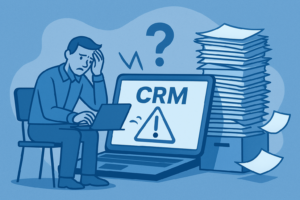 It is a hard question. Most businesses blame the platform. They say it was too complex, too limited, too slow, or too expensive. Yet in many cases, the real problem started long before the first login.
CRM failure rarely happens because of poor technology. It happens because companies rush into buying software before mapping their sales process, preparing their team, or defining success.
This article examines why CRM projects collapse early and how to prevent that outcome with a structured, intentional rollout.
The Real Problem: Buying Software Before Mapping Sales Processes
One of the most common and costly mistakes businesses make is purchasing a CRM before clearly defining how they sell.
Sales teams often operate with informal systems. Leads come in through email, WhatsApp, referrals, website forms, or phone calls. Some reps track information in spreadsheets. Others rely on memory. Management assumes that installing a CRM will automatically fix this chaos.
It will not.
If a business has not mapped:
-
How leads are captured
-
How are they qualified
-
What stages a deal moves through
-
Who owns each stage
-
What triggers follow-up actions
then the CRM simply digitises confusion.
Without clarity, teams create inconsistent pipelines. Fields are left blank. Reports become unreliable. Within months, management concludes that the CRM “doesn’t work.”
The software was never the problem.
Intentional CRM implementation begins with process design, not product selection.
The Hidden Costs Nobody Talks About
When businesses budget for a CRM, they often focus only on subscription fees. The true cost of a CRM implementation includes several hidden components.
1. Data Migration
Moving customer data from spreadsheets, email systems, or legacy software takes time. Data is often messy, duplicated, or incomplete. Cleaning it requires hours of administrative effort.
2. Integrations
CRMs rarely operate in isolation. They connect with accounting software, email platforms, quoting tools, and marketing systems. Integration setup may require technical support or paid connectors.
3. Staff Training
Training is not optional. Even simple systems require onboarding. Without structured training sessions, staff revert to old habits.
4. Temporary Downtime
During rollout, productivity can dip. Sales reps adjust to new workflows. Reports may need refinement. Managers may need to troubleshoot adoption issues.
Ignoring these hidden costs leads to frustration. Teams feel blindsided. Leadership loses patience. Momentum fades.
A realistic plan anticipates these factors from day one.
The Feature Overload Trap
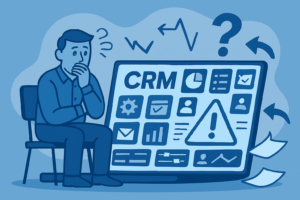 Another major reason CRM projects fail is feature overload.
Many vendors market platforms with hundreds of features: marketing automation, forecasting dashboards, AI suggestions, workflow builders, document management, advanced reporting, and more.
For small and mid-sized businesses, this can be overwhelming.
When users open the system and see too many options:
-
They become unsure what to use.
-
They fear making mistakes.
-
They avoid deeper adoption.
-
They use only 10 percent of the platform.
Feature overload creates paralysis.
For businesses seeking minimal disruption and low complexity, Less Annoying CRM offers a deliberately simple structure. It focuses on contact management, pipeline tracking, and task follow-ups without unnecessary layers. That simplicity often leads to faster team adoption.
For businesses with more structured sales processes that still want to avoid enterprise pricing shock, Capsule CRM provides clear pipeline management, activity tracking, and integrations while remaining accessible and manageable.
Choosing a CRM aligned with operational maturity is critical. More features do not equal more success.
Leadership Buy-In Determines Adoption
Even the most thoughtfully selected CRM will fail without leadership commitment.
If managers do not:
-
Use CRM reports in meetings
-
Insist that opportunities be logged
-
Review pipeline data regularly
-
Reward proper usage
then adoption weakens quickly.
Staff take cues from leadership. If executives continue asking for spreadsheets or accepting informal updates, the CRM becomes optional.
Leadership must communicate three things clearly:
-
Why the CRM matters
-
How it improves individual performance
-
That usage is non-negotiable
CRM implementation is not an IT project. It is a behavioral shift.
When leaders model the change, adoption rates improve dramatically.
Creating a 90-Day CRM Rollout Plan
Planning reduces risk. A structured 90-day CRM rollout plan allows teams to implement gradually while maintaining business continuity.
Days 1–30: Strategy and Preparation
Objectives:
-
Map sales processes
-
Define pipeline stages
-
Identify required fields and reports
-
Clean and organise existing data
Key actions:
-
Interview sales staff about current workflows
-
Document lead sources and qualification criteria
-
Standardise deal stages
-
Decide what success metrics will be tracked
Only after this stage should final software configuration begin.
Days 31–60: Configuration and Pilot
Objectives:
-
Set up pipelines and fields
-
Import clean data
-
Integrate essential tools
-
Train a small pilot group
Key actions:
-
Conduct structured training sessions
-
Assign internal CRM champions
-
Run the CRM in parallel with old systems
-
Collect feedback and refine workflows
This phase identifies friction before full deployment.
Days 61–90: Full Rollout and Reinforcement
Objectives:
-
Company-wide adoption
-
Leadership reporting via CRM dashboards
-
Performance monitoring
Key actions:
-
Make CRM usage mandatory
-
Replace legacy tracking systems
-
Review data accuracy weekly
-
Celebrate early wins
By the end of 90 days, the CRM should feel embedded in daily operations rather than imposed from above.
Why Planning Reduces Financial Risk
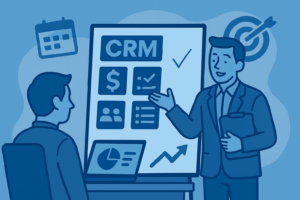 Many businesses abandon CRM projects within the first year. Subscription fees continue while usage drops. Staff revert to manual tracking. Management loses visibility.
This is avoidable.
An intentional CRM implementation ensures:
-
Budget clarity
-
Realistic timelines
-
Clear accountability
-
Measurable ROI
Instead of reacting to problems, leadership anticipates them.
The Discipline of Intentional CRM Implementation
The phrase “intentional CRM implementation” is more than a strategy. It is a mindset.
It requires businesses to:
-
Design processes before choosing tools
-
Budget for training and integration
-
Select software appropriate to operational maturity
-
Commit leadership to active usage
-
Follow a structured rollout plan
When these principles are ignored, CRM projects stall before they truly begin.
When they are applied, CRM systems become operational assets rather than expensive databases.
Final Thought
CRM software does not fail companies. Poor planning does.
Before purchasing another system, leadership should pause and ask:
Are we solving a software problem… or a process problem?
The answer determines whether the next CRM investment becomes a growth engine or another forgotten login.