
Where Customers Search: How Small Businesses Get Found Online
– SmallBizCRM Staff – November 12th, 2026
Why being visible in the right places matters more than ever
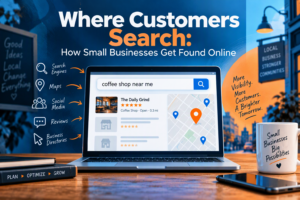 Having a website is no longer enough to guarantee that potential customers will find a business. With so many companies competing for attention online, small businesses need to think carefully about where their customers search, what information they want and how they make purchasing decisions.
A potential customer might discover a business through a Google search, a social media recommendation, an online directory, a review website or an article answering a specific question. If a business is absent from these places, it risks losing opportunities to competitors who are easier to find.
The goal is not to be everywhere. It is to show up where customers are searching, provide useful information and make it easy for interested people to take the next step.
For small businesses with limited marketing budgets, this approach can make a considerable difference.
1. Understand where potential customers look
Before investing time and money in online marketing, businesses need to understand how their target customers search for products and services.
Different customers use different channels. Someone looking for a local plumber might turn to Google Maps, while a business owner searching for accounting software may read comparison articles, customer reviews and specialist websites.
Common places where customers discover businesses include:
- Search engines: Google remains an important starting point for people researching products, services and solutions.
- Google Business Profile: Particularly useful for businesses serving customers in specific geographical areas.
- Social media: Facebook, LinkedIn, Instagram and other platforms help businesses build awareness and engage with potential customers.
- Online directories: Industry-specific directories can connect businesses with people already looking for particular services.
- Review websites: Independent customer feedback can influence purchasing decisions and build confidence.
- Blogs and specialist publications: Helpful articles can attract people researching a problem before they are ready to buy.
The important point is to identify which channels are relevant to the intended audience rather than trying to maintain a presence on every platform.
2. Make search engine visibility a priority
Search engine optimisation (SEO) helps businesses improve their chances of appearing when people search for relevant information.
A well-optimised website should clearly explain what the business offers, who it serves and how its products or services solve customer problems.
For businesses looking to improve online visibility for small business websites, several practical steps can help:
Use relevant keywords. Think about the actual words and phrases customers type into search engines. Include these naturally in page titles, headings, descriptions and website content.
Write useful website pages. Each important product or service should have a dedicated page explaining what is offered, who it is suitable for and what customers can expect.
Publish helpful articles. Answering common questions gives search engines more relevant information to understand and potentially display.
Improve website performance. Pages should load quickly, work properly on mobile devices and offer a straightforward browsing experience.
Keep information accurate. Contact details, prices, service descriptions and business information should be current.
SEO is not an overnight solution. It requires consistent attention, but a well-maintained website can continue attracting relevant visitors long after an article or page has been published.
3. Don’t overlook local searches
For businesses serving a particular town, city or region, local visibility can be especially valuable.
People frequently search for businesses using phrases such as “accountant near me”, “electrician in Cape Town” or “best coffee shop in Johannesburg”.
Local search marketing for small businesses helps companies appear when potential customers are looking for nearby products and services.
A good starting point is a Google Business Profile. Businesses should complete their profile with:
- Accurate business name, address and telephone number.
- Opening hours and service information.
- Relevant business categories.
- Good-quality photographs.
- A link to the business website.
- Genuine customer reviews.
Customer reviews deserve particular attention. Positive feedback can build trust, while thoughtful responses to negative reviews demonstrate that a business takes customer concerns seriously.
Local visibility is not limited to Google. Relevant local directories, community websites and industry associations can also provide useful opportunities to be discovered.
4. Give customers a reason to visit your website
Getting someone to find a business online is only the beginning. The website must give visitors a reason to stay, explore and make contact.
Customers are generally looking for answers, not marketing slogans.
A business website should quickly communicate:
- What the company does.
- Which customers it serves.
- What problems it solves.
- Why its products or services are worth considering.
- How visitors can make an enquiry.
One effective way to attract visitors is through useful educational content.
For example, an accounting firm might publish an article explaining common tax mistakes made by small businesses. A software provider could compare different solutions for managing customer information. A marketing consultant might explain how to generate enquiries without a large advertising budget.
The aim is to create content that answers customer questions rather than simply promoting the company.
This approach helps establish credibility and introduces potential customers to a business before they are ready to make a purchasing decision.
5. Use social media strategically
Social media provides another opportunity to reach customers where they spend time online.
However, businesses do not need to be active on every platform. The right choice depends on the audience and the nature of the business.
LinkedIn may be appropriate for professional services and business-to-business companies. Instagram can work well for visually appealing products, while Facebook can help local businesses connect with communities and existing customers.
Rather than publishing promotional messages every day, businesses should aim for a balanced approach.
Useful social media content includes:
- Practical tips and advice.
- Answers to frequently asked questions.
- Customer testimonials and success stories.
- Product demonstrations.
- Industry news and useful observations.
- Links to relevant website articles.
Consistency matters, but quality is more important than publishing simply to maintain a schedule.
Social media should also encourage conversations. Responding to comments, answering questions and following up on enquiries can help turn initial interest into meaningful business relationships.
6. Make it easy for interested customers to get in touch
A business can attract considerable website traffic without generating many enquiries. This often happens because visitors cannot easily see what to do next.
Every important website page should provide a clear next step.
Depending on the business, this could be:
- Requesting a quotation.
- Booking a consultation.
- Arranging a demonstration.
- Signing up for a newsletter.
- Downloading a useful guide.
- Making a telephone enquiry.
Contact forms should be straightforward. Asking visitors to complete lengthy forms before they have established trust can discourage enquiries.
It is equally important to respond promptly when someone makes contact. A potential customer who receives no response may simply approach a competitor.
This is where an organised lead management process becomes valuable.
7. Turn online visibility into lasting customer relationships
Attracting visitors and generating enquiries are important, but businesses also need a reliable way to manage the people who show an interest.
Customer Relationship Management (CRM) software can help bring these activities together.
A CRM system provides a central place to record customer details, track enquiries, manage follow-ups and monitor sales opportunities.
For example, imagine a small consulting business attracting enquiries through its website, LinkedIn page and Google Business Profile.
Without an organised system, enquiries might end up scattered across email accounts, spreadsheets and telephone messages. Some potential customers may receive a response immediately, while others are forgotten.
A suitable CRM can help the business:
- Store customer and prospect information in one place.
- Record where enquiries originated.
- Track conversations and sales opportunities.
- Schedule reminders for follow-ups.
- Monitor progress through the sales process.
- Maintain relationships with existing customers.
The result is a more organised approach to handling the interest generated by online marketing.
For smaller businesses, a straightforward CRM may be sufficient. The best solution is not necessarily the one with the most features, but the one that fits the business’s requirements and is easy for the team to use consistently.
8. Measure what is working
Online visibility should be measured by more than website visitor numbers.
Businesses need to understand which channels attract relevant visitors and which ones generate genuine enquiries.
Useful measurements include:
- Website visits and organic search traffic.
- Search terms that bring visitors to the website.
- Pages attracting the most attention.
- Enquiries received through different channels.
- Conversion rates from visitors to leads.
- The number of leads that eventually become customers.
Google Analytics and Google Search Console can provide valuable information about website performance and search visibility. A CRM can help track what happens after someone enquires.
Reviewing these figures regularly helps businesses identify which marketing activities deserve more attention and which may need improvement.
Final thoughts: Be present when customers need you
Small businesses do not need enormous marketing budgets to become easier to find. They need a clear understanding of their customers, a useful online presence and a consistent approach to building relationships.
The most effective strategy is to focus on the places where potential customers are already looking, provide information that helps them make decisions and make it simple for them to get in touch.
Being visible creates the opportunity. Providing value builds confidence. Following up turns interest into business.
And that is the real objective: not simply to attract more website visitors, but to be found by the right people, earn their trust and build customer relationships that last.